
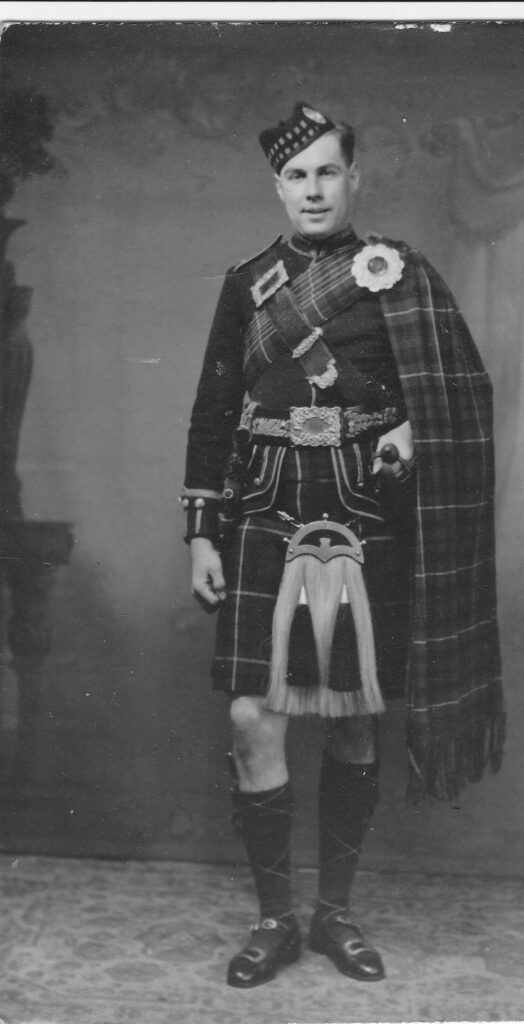
Havelock Passchendaele Morris was born on 19 July 1918, in Chignecto, Cumberland, Nova Scotia. His middle name was chosen in honor of a relative who fought in the Battle of Passchendaele in the First World War.
Havelock Morris (22) married Kathryn (Kate) Mary Burke (20) on 12 July 1941, in River Hébert, Nova Scotia. Six days later Lance-Corporal H.P. Morris and his three older brothers embarked on the S.S. Orion with the North Nova Scotia Highlanders in Halifax. The S.S. Orion sailed for England on 21 July 1941 in a convoy (TC-12) among five great troopships. The convoy of over 17,000 Canadian troops. The convoy arrived in Avonmouth, England on 30 July 1941.
On 10 June 1940, Havelock Passchendaele Morris answered the call and volunteered for active service with the Canadian Army for sixty-four months of which thirty months (21 July 1941 – 31 January 1944) were overseas during the Second World War. He was a trained mortarman (3-inch trench & spigot) and instructor. Captain Havelock Morris, CD dedicated twenty-two years of qualifying service with the Canadian Army (Reserve Force). For his service Captain Havelock Passchendaele Morris, CD was awarded the Canadian Volunteer Service Medal & Clasp, Defence Medal, War Medal 1939-45 and Canadian Forces’ Decoration & 1st Clasp.
All of Havelock Morris’ brothers enlisted with the Canadian Army (Active) North Nova Scotia Highlanders, R.C.I.C. Clarence, 23, Havelock, 21, and Cecil, 31, enlisted on 10 June 1940 in Amherst. Arthur, 29, enlisted on 17 June 1940 at No. 6 District Depot in Halifax. All were among the fortunate few to return home after serving overseas during the Second World War.
The Morris brothers underwent Basic Training in Amherst from June 1940 to May 1941 followed by Advanced Training in Camp Debert from May 1941 to July 1941 prior to departing for England. After arriving in Avonmouth, England on 30th July 1941, Lance Corporal Havelock Morris engaged in thirty months of training and operational readiness with the North Nova Scotia Highlanders initially at Aldershot then shifted primarily to the Southern regions of England, close to the English Channel followed by a period of intense training in Scotland which included amphibious landings.
In December of 1941, Acting Corporal Morris attended the Eastern and South Eastern Command Weapon Training School on the Old Bury Hill estate near Dorking, Surrey, England participating in Spigot and 3-inch Mortar training.
Corporal Havelock Morris and his older brothers (Corporal Arthur Morris) were among eight North Nova Scotia Highlanders selected for Mortar training at the Canadian Army Battle Drill School from 30 August 1942 to 19 September 1942. Operating as No. 5 (Battle) Wing within the Canadian Training School the school’s curriculum went far beyond traditional parade-ground training to provide intense “battle indoctrination”.
Upon completing his overseas service on 31 January 1944, Sergeant Morris was selected as a 48th Quota Reinforcement Officer Candidate (Cadet). He reported to the Canadian Training Army/Associated Air (C.T.A.A.) training commencing on 25 February 1944 at the Canadian Officers Training Centre in Brockville, Ontario. After successfully completing the officers’ training on 15 July 1944, he qualified as 2nd Lieutenant (Infantry). He was subsequentially transferred to the Canadian Infantry Training Centre (A14) “D” Coy in Aldershot, N.S.
During his term with the Canadian Infantry Training Centre in Aldershot, Lieutenant Havelock Morris received entitlement to wear Distinguishing Formation Patches (3rd Canadian Division) on 20 April 1945 and Qualified Driver I.C. (MV) and Qualified Motorcyclist on 1 July 1945. Lieutenant Morris was struck off strength on 18 October 1945 returning to employment in River Hébert. Lieutenant Morris’ superiors described his military character as “Excellent”.
On 15 April 1947, Lieutenant Havelock Morris re-enlisted and served in the Canadian Army Militia “HQ” Coy with the North Nova Scotia Highlanders completing annual training each year. On 15 December 1948, he was promoted to Captain as Officer in Charge of the 3-inch Mortar Platoon “SP” Coy with the North Nova Scotia Highlanders. On 1 August 1959, Captain Morris was appointed 2nd In Command of “F” Coy, Amherst. He was covering the appointment of Signal Officer, “HQ” Coy, Amherst at the time.
Captain Morris was a life-long member of the Royal Canadian Legion, Branch No. 14 serving many offices including President for several years. He was also a member of the North Nova Scotia Highlanders Memory Club serving as the representative for River Hébert.
Captain Morris’ remarkable legacy of service is carried on through his daughter, Dayle, along with her husband Wade Quinn and only grandson, David. Following in his grandfather’s footsteps, David was an active and leading Cadet with the 1442 River Hébert Royal Canadian Army Cadet Corps and a respected member in River Hébert.
Captain Morris passed away suddenly on 19 September 1977, in River Hébert, Nova Scotia. He is buried in the River Hébert Cemetery in River Hébert, Nova Scotia.